
Is Your Business Losing Revenue It Already Has?
When sales stall, the usual answer is to spend more on bringing customers in. First find out how many you are already losing: a 30-day trace of your enquiries shows it.

Before you choose a growth strategy, check what happens to the enquiries you already have. Take every enquiry from the last 30 days and record when it was first answered, whether a quote went out, whether anyone followed up and where it ended. If many are unanswered, unfollowed or unknown, the problem is probably how demand is handled, not how much of it there is, and much of any extra advertising will be wasted. Fix the handling first. AI now makes a simple tracking tool easy to build.
This is my view, not a measured finding. I found no study that measures how many small-business enquiries go unfollowed, so this article gives no typical figure. It shows you how to find your own.
The growth strategy question that comes before more advertising
When sales stop growing, the most common response is to spend more on bringing customers in: more advertising, another salesperson, new software. My view is that one question should come first. How many customers are you already losing?
If some of today's enquiries go unanswered or are never followed up, more advertising does not fix the problem. It sends more enquiries into the same leak. Some of the extra leads will still turn into sales, so the money is not all wasted, but a large share of it is.
Before asking "how much more should we spend?", ask "what did we do with the enquiries we have already paid for?"
This is one decision, not a full growth plan: when growth slows, whether to look first at new demand or at the demand you already have. One month of tracing can answer it, without buying anything.
Two problems: follow-up and visibility
The first problem is follow-up. Some enquiries and quotations are simply never chased.
The second is visibility. In many small UAE businesses, in my experience, enquiries and quotations live in WhatsApp, in spreadsheets and in salespeople's heads. The owner cannot see how many opportunities came in or what happened to each one. An owner who cannot see that cannot tell whether the business is short of customers or is losing the ones it has.
WhatsApp is central to this. In a 2024 YouGov survey of 1,000 UAE residents, commissioned by a company that sells WhatsApp commerce tools, 65% said they had used WhatsApp in the past year to ask a business about a product or service (Communicate). That makes WhatsApp a front door for enquiries. It also means many enquiries sit on individual phones, outside any shared record.
Research on large sales teams points the same way. A study of 461 sales representatives at four firms found that whether reps followed up a lead depended partly on whether managers tracked it (Sabnis et al.). What is not tracked tends not to be done.
A forgotten enquiry is a bad customer experience
From the customer's side, a forgotten enquiry is not a lost sale. It is silence, having to chase for a quote, having to explain the same thing twice. The Effortless Experience, by Matthew Dixon, Nick Toman and Rick DeLisi, argues that loyalty depends more on how much effort customers have to make than on being delighted. Chasing a business for an answer is exactly that kind of effort.
Bad experiences also travel. Research on online reviews found that a better rating was associated with higher revenue for independent restaurants but not for chains (Luca), and that a negative review can hurt sales more than a positive one helps (Chevalier and Mayzlin). Small independent businesses have the most to lose.
I see the UAE as one of the markets where this matters a great deal. That is my reading, not a finding: I found no rigorous study showing that customers here are more sensitive than customers elsewhere. My reasoning is that in a market with a strong taste for premium service, and in cities that are expensive to live in, expectations rise. Mercer's 2024 cost-of-living ranking placed Dubai 15th in the world and the most expensive city in the Middle East for international employees (Gulf Business). That illustrates the premise. It does not prove the link to expectations; the link is my inference.
The 30-day enquiry trace: business process improvement you can start this week
Good business process improvement starts by looking at what a process actually does before changing it. Here, that means taking every enquiry from the last 30 days and asking five questions about each one. A simple table is enough to start.
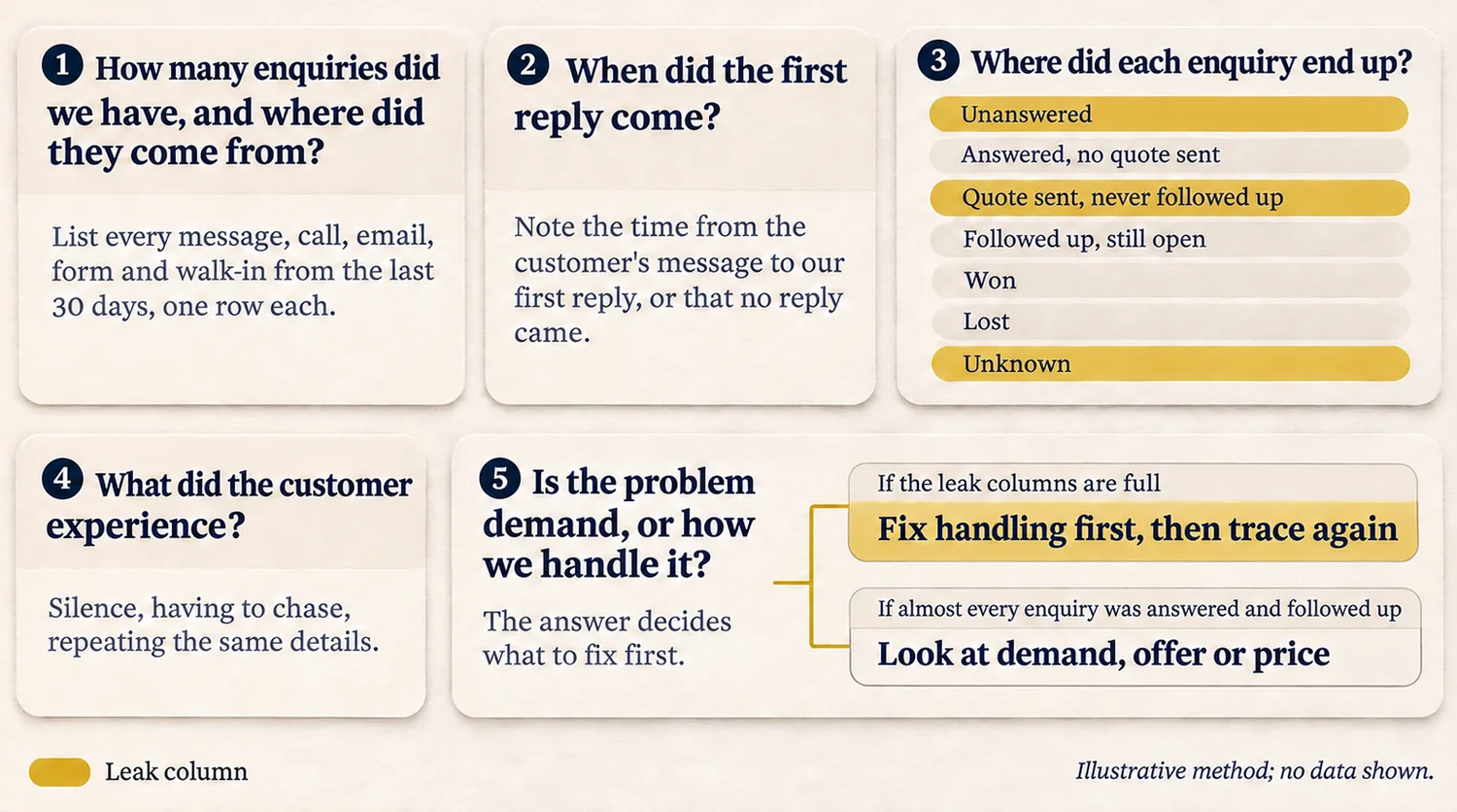
The five questions of the 30-day trace. Three of the seven statuses are leak columns. Illustrative method; no data shown.
| Question | What to record | What it tells you |
|---|---|---|
| 1. How many enquiries did we have, and from where? | One row per WhatsApp message, call, email, website form and walk-in | If you cannot complete the list, visibility is your first finding |
| 2. When did the first reply come? | Time from the customer's message to the first reply, or no reply | Whether response time is part of the problem |
| 3. Where did each enquiry end up? | One status: unanswered; answered, no quote sent; quote sent, never followed up; followed up, still open; won; lost; unknown | How full the leak columns are |
| 4. What did the customer experience? | For each unanswered, unfollowed or unknown row: silence, having to chase, having to repeat themselves | Where a missed sale became a reputation risk |
| 5. Is the problem demand, or how we handle it? | The leak columns read together | Where to look first |
The "unknown" status is the leak the owner does not see. Researchers writing in Harvard Business Review blamed slow responses in large firms on how leads were pulled from CRM systems and distributed among salespeople. In a small business the cause is usually simpler: the enquiry was lost in a WhatsApp thread or in someone's memory.
Why response time deserves a column. The best-known evidence is from the United States. In 2011, researchers sent a test web enquiry to 2,241 US companies: 37% replied within an hour, 24% took more than a day and 23% never replied (Oldroyd, McElheran and Elkington, Harvard Business Review). Analysing 1.25 million leads at 42 US firms, the same authors found that firms that tried to contact a lead within an hour were nearly seven times as likely to have a meaningful conversation with a decision maker as firms that tried an hour later. A much larger and more recent study of 11.7 million conversations on Fiverr found that slower first replies went with fewer purchases (Hart et al., Management Science); the authors' experiments suggest buyers read speed as a signal.
These are associations from other markets. They do not prove that speed alone causes sales, and fast responders may be better in other ways. They are a reason to look at response time, not a forecast of what fixing it will earn.
Reading the result. If almost every enquiry was answered quickly, followed up and still lost, the problem is probably demand, the offer or the price, and more advertising or a change to the offer may be the right move. If the unanswered, unfollowed and unknown columns are full, fix the handling first, then repeat the trace a month later. The trace does not prove a cause. It tells you where to look first.
A hypothetical example: 64 enquiries in one month
This is a teaching example. The company, people and numbers are invented.
A small Dubai company installs and services air conditioning for villas and small offices. Besides the owner, it has a sales coordinator and a technical supervisor. Sales have been flat for several months, and the owner plans to double the Google Ads budget.
Enquiries arrive through the company's WhatsApp Business number, the coordinator's personal WhatsApp, phone calls and the website form. Quotes are built in Excel and sent by WhatsApp or email. Listing the month's enquiries takes two days, because some messages exist only on the coordinator's phone. The final count is 64.
| Status (hypothetical) | Count |
|---|---|
| Unanswered | 7 |
| Answered, no quote sent (not a fit, or the customer went quiet) | 16 |
| Quote sent, never followed up | 9 |
| Followed up, still open | 6 |
| Won | 13 |
| Lost, with a recorded reason | 7 |
| Unknown | 6 |
| Total | 64 |
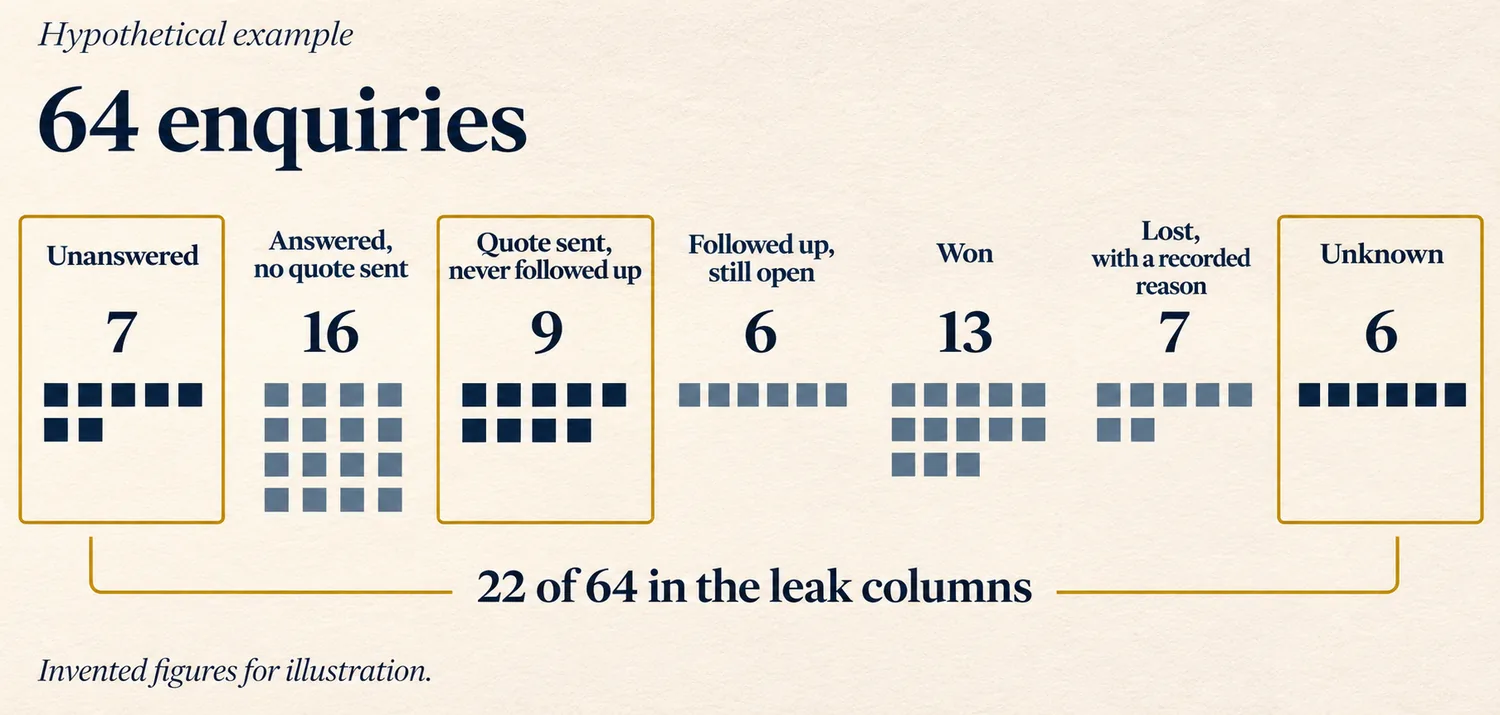
Hypothetical example: invented figures for illustration, not a typical leak rate.
The conversations show the customer's side. Two customers messaged to ask what had happened to their quote. One sent the address and unit model three times, to three different people.
Twenty-two of the 64 invented enquiries sit in the three leak columns: unanswered (7), quote never followed up (9) and unknown (6). The owner cannot say how many of these would have become sales, and the example makes no claim about it. Multiplying the nine unfollowed quotes by the company's own average order value gives a ceiling on the opportunity the owner could not see. It is not money the company has certainly lost.
So the owner does not double the advertising budget yet. For one month, all enquiries move to one shared WhatsApp Business number, a simple tracker gives every enquiry a status and a next follow-up date, and one rule applies: no quote goes out without a follow-up date. Then the owner repeats the trace. If the leak columns have shrunk and sales are still flat, the advertising decision is revisited, this time with data.
Fix the process first, then let AI do the heavy lifting
AI has made building tools cheap. It does not design the process. First decide where each enquiry should end up and who owns it; then automate.
An AI agent placed on top of an unclear process only makes the leak faster.
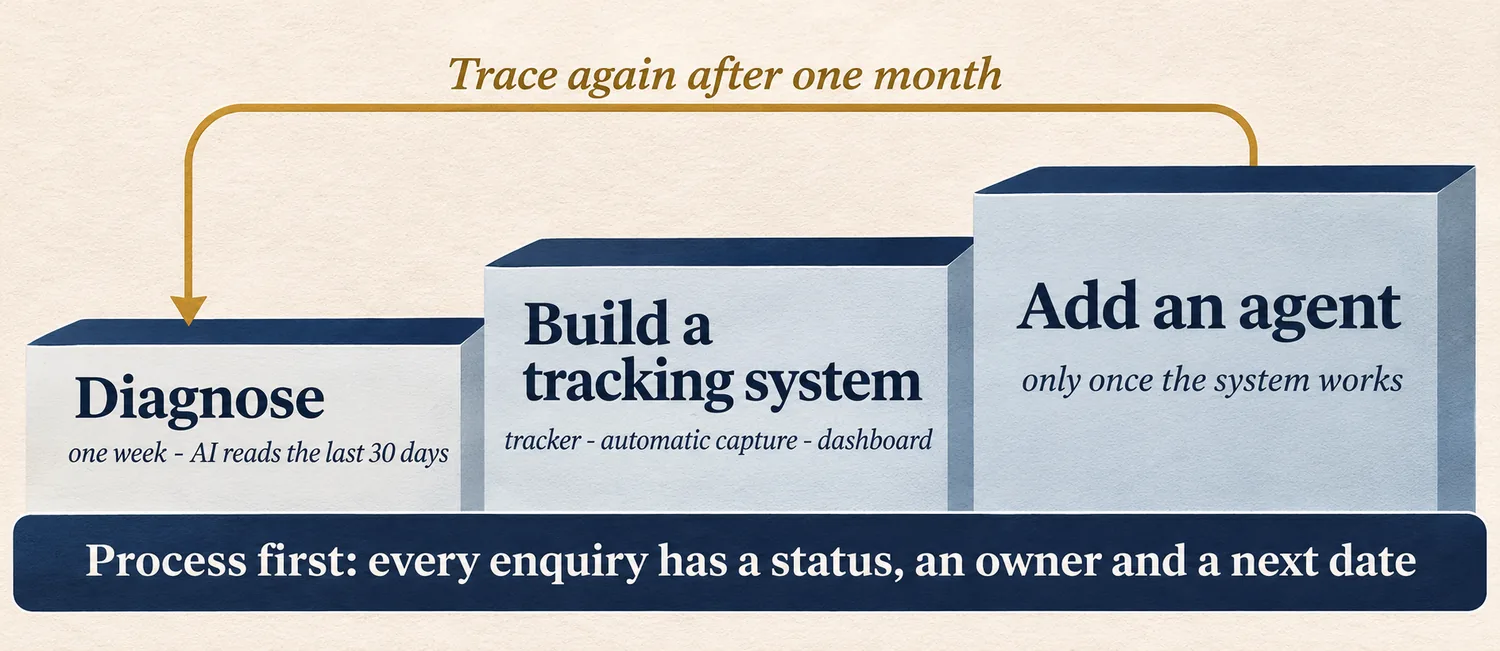
Process first: diagnose, build the tracking system, and add an agent only once the system works. Then trace again.
Diagnose with AI in a week. Export your WhatsApp chats; WhatsApp lets you export a conversation as a text file (WhatsApp Help Center). Add emails and form submissions, and ask an AI assistant to find only customer enquiries and list, for each one, the date, your first reply time, whether a quote was sent, whether it was followed up and the latest status. Tell it to write "unknown" where it is not sure, and not to guess. Check ten or fifteen rows against the original conversations. Before you do any of this, check how the tool stores data, and remove customer details you do not need.
Build a tracker that does four things. You do not need to buy a technical CRM and bend your business to fit it. Whatever you use should:
- record every enquiry in one shared place;
- give each one a status, an owner and a next follow-up date;
- show someone the overdue follow-ups every day;
- keep customer data safe.
There are three levels, and you do not need to start at the top:
- An afternoon, no code. Describe your process to an AI assistant and ask it to build the tracker: fixed statuses, a follow-up date, overdue rows highlighted and a summary sheet. Some assistants can now build a small shared app instead of a spreadsheet: a Claude artifact, for instance, can be published with storage that the whole team uses (Claude Help Center). Plans and storage limits apply, so check where the data is held before you add customer details.
- A few days, low code. Put an automation tool such as n8n, Make or Zapier between WhatsApp and the tracker, so that an AI model recognises each enquiry and adds a row, and each overdue follow-up reaches its owner every morning. Ready-made templates exist (n8n).
- Your own app. With AI app-building tools such as Claude Code, Lovable or Replit, you can build a small application with logins, roles and links from enquiry to quote to invoice. Some firms report replacing expensive CRMs this way. Make sure the tool and its data belong to you, access rules are set correctly, backups exist and someone knows how to fix it.
I have built many of these tracking and automation systems myself. I found no rigorous study of small-business owners building their own tracking tools with AI, so that part rests on practice, not research. The research on AI at work is mixed: a generative-AI assistant raised the number of issues resolved per hour in a large customer-support operation by about 14% on average (Brynjolfsson, Li and Raymond), while experienced developers in a 2025 trial were 19% slower with AI tools on their own projects, and believed they had been faster (METR). Measure, do not assume.
It is natural to find it hard to make time to learn new technology while running a business. You can get help from a specialist, reach the tool you need quickly and become proficient yourself over time. Just make sure the tool and its data are yours and you understand how it works.
Make capture automatic, then watch a few numbers. Move all enquiries to one shared WhatsApp Business number, not personal phones, and send website forms and emails straight into the tracker. Connecting WhatsApp to other tools runs through Meta's WhatsApp Business Platform via a provider: messages customers send you are free, and the business pays per message for template messages it sends (Meta for Developers). Then watch enquiries per week by channel, median time to first reply, open quotes without a follow-up date, unanswered and unknown enquiries, and conversion from enquiry to sale. When enquiry, quote and invoice are linked, you can see what a sale from each advertising channel costs, and decide on the budget with data.
Add an agent only once the system works. An agent on WhatsApp can reply immediately, even outside working hours, gather the details needed for a quote, record the enquiry and draft follow-ups for a person to approve. Set clear rules: customers can always reach a human; the agent never gives prices or commitments the business has not approved; it does not pretend to be a person; and someone reviews its conversations regularly. A field experiment found that undisclosed chatbots sold about as well as skilled staff, but telling customers at the start that they were talking to a bot sharply reduced purchases (Luo et al.). That is not an argument for hiding a bot. It is a reason to make the agent genuinely useful and keep a human within reach.
After a month, compare the dashboard with your first trace. If the leak columns have shrunk and sales are still flat, it is time to look at demand, price or the offer.
What the evidence supports, and what it does not
The evidence supports the direction of this argument, not a number. Slow and missing replies are common where they have been measured, and faster replies go with better outcomes. Studies of small firms in developing countries find that record keeping and sales tracking go with higher sales and survival (McKenzie and Woodruff), and US data show that structured management practices become more common as firms grow (Bloom et al.). Both are associations, and neither is a GCC sample.
Keep these limits in mind:
- There is no typical leak figure. No study measures how many small-business enquiries go unfollowed. "This happens often" is my experience, and the example's numbers are invented.
- Speed and sales are associated, not proven cause and effect. The studies come from the United States and a global online marketplace, not small UAE businesses.
- Vendor statistics are left out. Figures about response speed and follow-up are repeated everywhere in sales-software marketing. I could not trace them to reliable studies.
- Tracing the past is incomplete, and one month may not be representative. Some messages sit on personal phones, and seasons matter. With small numbers, read the individual cases rather than the percentages.
- Not every unanswered enquiry is a lost sale. Some were not a fit; some customers were only comparing prices.
- Fixing handling will not fix price or product. If enquiries were answered fast, followed up and still lost, the problem is elsewhere.
- AI-built tools have their own risks. A model can misread a conversation. In 2025, a security researcher found that 170 apps built with one popular AI app builder let anyone read user data because database access rules were missing (CVE-2025-48757).
- Customer privacy matters. In the UAE, personal data is governed by Federal Decree-Law No. 45 of 2021, and some free zones, such as DIFC and ADGM, have their own regimes. Check your obligations before putting customer conversations into any tool, and take legal advice if you are unsure.
When every enquiry sits on one salesperson's phone, that is also a key-person problem: see how to systemize a business without founder bottlenecks. For deciding on incomplete information, see predictive analytics for UAE SMEs. For other processes worth automating once enquiry handling is clear, see the business processes UAE SMEs should automate first.
The full report, with every source, the complete AI prompts and more answers to common questions, is available as a PDF. Request it with the form on this page and the link is sent to you by email.
Frequently asked questions
Is fixing enquiry handling a business growth strategy?
It is the check that comes before choosing one. If the trace shows that most enquiries were answered quickly, followed up and still lost, look at demand, the offer, price or competition. If many were unanswered, unfollowed or unknown, handling them properly is the cheaper place to start, and any later advertising goes into a system that can follow it up.
Should I stop advertising while I trace my enquiries?
Not necessarily. The suggestion is to hold the budget where it is, not to switch it off. The trace takes a month; after that you can decide with evidence.
Do I need to buy a CRM?
No. What matters is that every enquiry is recorded in one shared place, each has a status, an owner and a follow-up date, and someone checks the overdue ones every day. A spreadsheet, a small app you build with AI or a CRM will all do, if they do that.
I only get a few enquiries a month. Is a trace still worth doing?
Yes, but do not draw firm conclusions from percentages. With small numbers, one or two cases move the figures a lot. Read the individual cases instead: which were left unanswered, and why. If your business is seasonal, pick a representative month or trace over a longer period.
Start with last month's enquiries
Pick one month, list every enquiry and give each one a status. The rows you cannot place are part of your answer.
If your trace shows a handling problem and you want help building the tracker, capture and dashboard around how your business already works, see how Radman designs the process first and then builds the system.